Aireborough Family Services
Aireborough Family Services are core funded by schools, with additional supplementary resource commissioned from NHS England, and targeted services investment from Leeds City Council. The service retains its purpose and remit to provide early intervention, therapeutic and family support services for children, young people and families accessing schools within the Aireborough Cluster.
Schools within the Aireborough Cluster are:
|
Guiseley High school |
Benton Park High school |
|
St Mary’s Menston High school |
Rufford Park Primary school |
|
Tranmere Primary school |
Westfield Infants Primary school |
|
Queensway Primary school |
Westfield Juniors Primary school |
|
Guiseley Primary school |
Rawdon Littlemoor Primary school |
|
St Oswald’s Primary school |
Rawdon St Peters Primary school |
|
Hawksworth Primary school |
St Peter and St Paul Primary school |
The Aireborough Cluster Team is shown in the table below:
|
Role/s |
Name/s |
Days |
Employer |
|
Integrated Services Leader |
Dawn Jennings dawn.jennings@aireboroughxs.co.uk |
Wed - Fri |
AFS/Benton Park School |
|
Integrated Services Leader |
Jemima Lutter jemima.lutter@aireboroughxs.co.uk |
Mon, Tues & Friday |
AFS/Guiseley School |
|
Cluster Administrator |
Julia Whiteley julia.whiteley@airboroughxs.co.uk |
Tues - Thurs |
AFS/Guiseley School |
|
Family Support Workers |
Karen Coburn karen.coburn@aireboroughxs.co.uk
Lisa Matheson lisa.matheson@aireboroughxs.co.uk |
Tues - Fri
Mon - Fri |
AFS/Guiseley School
AFS/Guiseley School |
|
Primary Mental Health and Well-being Practitioner |
Julie Bentley-Craven julie.bentley-craven@aireboroughxs.co.uk |
Mon – Wed |
AFS/Guiseley School |
|
School Therapeutic Counsellors |
Sally Scargill sally.scargill@aireboroughxs.co.uk
Rachel Tandy rachel.tandy@aireboroughxs.co.uk
|
Mon - Thurs
Mon - Fri |
Northpoint Wellbeing |
Intended Remit and Outcomes
- Safeguarding and promoting the welfare of children is everyone’s responsibility. ‘Children’ includes everyone under the age of 18. Everyone who comes into contact with children and their families has a role to play. In order to fulfil this responsibility effectively, all practitioners should make sure their approach is child centred. This means that they should consider, at all times, what is in the best interests of the child. (Keeping Children Safe in Education 2025).
- To strengthen stability, safety, and positive parenting with families across the Aireborough Cluster of schools.
- To improve learning and longer-term wellbeing outcomes by addressing family, environmental, social, emotional, and personal barriers to school attendance, engagement, and potential attainment.
- To improve the quality of communication, relationships, and boundaries within families and across agencies.
- To reduce negative, dysregulated or anti-social behaviour and promote, support, and increase pro-social and positive behaviour for children/young people and families.
- To address low level SEMH issues and needs as early and effectively as possible, again where appropriate preventing escalation and entrenchment of harm.
- To gather information, evidence, and observations to guide and support referrals on to other specialist or commissioned resources, where needs and intended outcomes cannot be met at Cluster level.
- To work in close partnership with school leads and where relevant other agencies to establish, lead or support clear and agreed Early Help Plans and work.
- To prevent escalation of risk, and where safe and appropriate prevent need for statutory or specialist services or the need for children to be looked after.
- No single practitioner can have a full picture of a child’s needs and circumstances. If children and families are to receive the right help at the right time, everyone who comes into contact with them has a role to play in identifying concerns, sharing information and taking prompt action. Safeguarding and promoting the welfare of children is defined for the purposes of this guidance as:
- Providing help and support to meet the needs of children as soon as problems emerge
- Protecting children from maltreatment, whether that is within or outside the home, including online
- Preventing the impairment of children’s mental and physical health or development
- Ensuring that children grow up in circumstances consistent with the provision of safe and effective care
- Taking action to enable all children to have the best outcomes (Keeping Children Safe in Education 2025).
Core Functions and Exclusion Criteria for Aireborough Family Services
|
Services we provide |
Services we cannot provide |
|
|
|
|
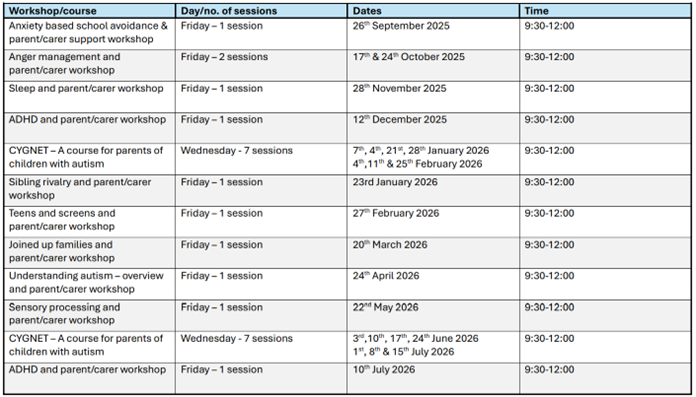
Any safeguarding concerns, neurodiversity or other more complex and risky behaviours, that arise through observed therapeutic or direct family support sessions, or groupwork interventions, will be offered as supporting evidence to supplement requests for specialist support, or to escalate concerns to Family Hubs or CSWS, for specialist support. The cluster also run courses throughout the year to support families. A list of course dates can be found in the table below. Please contact Mrs Oliver should you need any more information or help booking a place.
|
|